Tuesday, May 30, 2023

News brief: Drones hit Moscow

 Russian-language media report that a drone with a two-meter spread has just hit a 16-story apartment building in Moscow.  They show video of the attack. Several other drones were reported. Moscow Mayor Sergey Sobranin said there were no serious injuries. No word on whether the drones came from the Ukrainians or from the Russians themselves, but they follow a drone attack on Kiev.  -- Leon Taylor, Baltimore, tayloralmaty@gmail.com

,

  Москву атаковали дроны: 30 мая 2023, 10:57 - новости на Tengrinews.kz

Saturday, May 13, 2023

Why cap debt?


                                             Matt Gaetz: The dark prince of debt?  Photo: AP

                                             Copyright: 2019 CQ-Roll Call, Inc.

Despite some progress in talks between Congress and the White House, default on the United States government debt rears its greedy head, thanks to hardliners like Representative Matt Gaetz (R-Florida).  “Gaslighting nearly $50 trillion in debt to America is something my conscious cannot abide at this time,” he declares in a press release.  The Congressman’s conscience and spelling are worthy of study.  Meanwhile, one may easily think that we should avoid future default crises by doing away with debt limits entirely.  But this cure may aggravate the disease.  

Excessive government debt is not a figment of the Republican imagination, as overactive as it is. Figure 1 shows that debt’s share of the economy has been rising since the administrations of President Ronald Reagan. It accelerated through the administrations of Barack Obama and, ah yes, Donald Trump. GOP bluster notwithstanding, it has fallen since Joe Biden took over in 2021.

The debt share rises in most recessions, shown by the shaded columns in the figure. That’s predictable.  To fight rising unemployment, governments borrow to spend more, which adds to debt. But after the recession, the debt usually keeps rising. Does debt addict?


Figure 1: The ratio of federal government debt to gross domestic product


Like fentanyl aficionados, governments can’t always help themselves.  Politicians buy your vote by offering you what you want, free of charge. They will gladly make our grandchildren pay, since the kids don’t vote today. Spend now, tax much later.  For example, conservatives may seek to cut taxes to the rich today, in exchange for their support. This tax cut may produce a deficit today: We spend more than we can immediately pay, so we must borrow.  Future taxpayers get stuck with the bill.

Conservatives are not alone in yielding to temptation. Consider Social Security.  Today’s workers pay for today’s retirees. In effect, tomorrow’s retirees finance today’s. But Social Security is politically untouchable: Retirees object more fiercely to cuts in benefits than workers do to increases in the Social Security tax.  This is partly because the worker thinks that she will get the tax hike back later in pension benefits, that by paying the tax she is just saving for herself. Wrong.  She won’t see that money again.

If Congressmen gain from shifting Social Security costs forward, then the share of Social Security spending in the economy should rise over time. Figure 2 is from Social Security's annual report for 2017. From 1975 to 2017, across age groups, the share tends to rise. In 1996, Congress passed legislation to curb Social Security spending, but it succeeded only until 2007.  Of course, the program's share of the economy depends on growth in the number of recipients and in the economy. Controlling for the average payment, if the number of recipients rises faster than GDP, the share will rise. But Congress should take this into account.

Figure 2: Social Security spending as a share of gross domestic product


Source: Social Security Administration

Congressmen may also spend more than we can afford because they can ignore us. Two Representatives on an appropriations committee may swap votes to approve their respective pork barrels, fobbing off the cost onto a Congress unlikely to object to their small deal. But many small deals add up to a big deal.

The bureaucracy too may press for spending. To bolster its salaries, it has reason to inflate its estimates of service costs. In the 1940s, a mule-headed Senator from Missouri, Harry Truman, made a name for himself by exposing military waste.  As late as the 1980s, Senator William Proxmire (D-Wisconsin) became famous, or more accurately infamous, for his Golden Fleece award for research grants that seemed frivolous. Today, the Congressional road to fame descends through the burgs of invective.  Never mind about cunning departments. Democrats eat babies, that’s the problem.

We are heading for default not because of a debt limit per se. The problem is that the debt limit we now have makes no sense, because it does not recognize that as the nation becomes richer, it can afford to borrow more. It is as if we limit a billionaire to the same $1,000 credit-card limit as applies to a high school student.  We should adjust the debt limit for the size of the economy by expressing it as a share of gross domestic product, as Figure 1 does.

The foggy road

Ideally, the debt limit would just be a guideline. Stuff happens. The government needs enough leeway to respond quickly to, say, another pandemic. It should also recognize that debt in and of itself is not bad. We may borrow today to study in college and earn higher income next year. And government spending does not depend only on the Congressional appetite for votes.  As Figure 2 shows, the projected share of Social Security in GDP fell after 2017, because the economy seemed to grow more quickly than the number of recipients. Evidently, the forecasters doubted that Congress would take advantage of these trends to raise benefits and thus votes. 

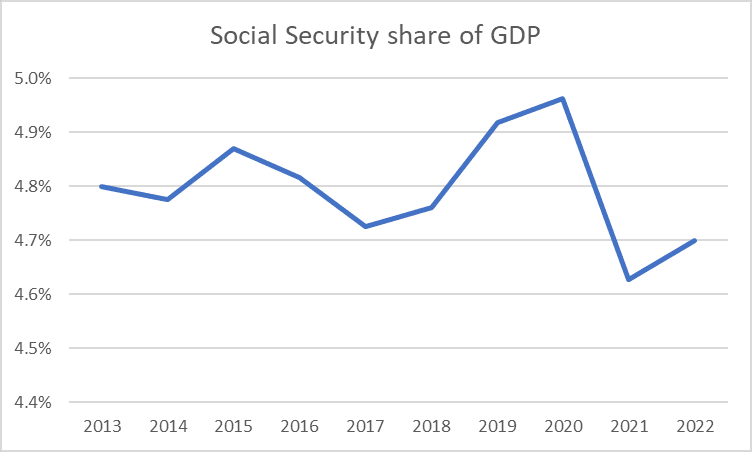
But Figure 3 shows the reality.  From 2013 to 2022, the Social Security share barely changes: 4.8% at the beginning of the decade, 4.7% at the end. The spike in 2020 was probably due to the Covid-19 lockdown of the economy. At any rate, there is no evidence in these figures that Congress took advantage of favorable trends to restrain Social Security spending by much.

Figure 3: Social Security spending as a percentage share of GDP


Sources: Nominal GDP, seasonally adjusted, FRED of the St. Louis Fed; Total outgo from OASDI Trust Fund, Social Security Administration.

The growing debt share is alarming, because it implies that most government investments do not pay off in economic growth. Perhaps they pay off in quality of life, but we don’t yet know. What we do know is that a rising debt share implies a growing tax bite from our income.  We don’t nead Gaetz, er, need Gaetz, to point that out. --Leon Taylor, Baltimore, tayloralmaty@gmail.com


References

Federal Reserve Bank of St. Louis.  FRED Economic Data: GDP.  Gross Domestic Product (GDP) | FRED | St. Louis Fed (stlouisfed.org)

Matt Gaetz.  Congressman Gaetz Issues Statement in Response to House Debt Ceiling Vote.  April 2023.  Congressman Gaetz Issues Statement in Response to House Debt Ceiling Vote | Congressman Matt Gaetz

Social Security Administration. 2017 annual report of the SSI program. D. Federal SSI Payments as a Percentage of Gross Domestic Product (ssa.gov)

Social Security Administration.  Time Series for Trust Fund Operations (ssa.gov)


Tuesday, May 9, 2023

Happy X-Day


Dueling duo: President Joe Biden and House Speaker Kevin McCarthy. Photo: Drew Angerer, Getty Images

Welcome to Apocalypse, population eight billion.

The United States government is virtually at its legal limit on debt. Without a higher limit, or lower spending, the government will not be able to pay its bills.  Democrats want to borrow more; Republicans want to spend less. If they don't agree in a few weeks, the government may default on its debt. Talks between Biden and McCarthy are going nowhere fast.   

Suppose that the US does default. What next?

As default approaches, investors will sell their US government bonds before they become mere paper.  Bond prices will fall, so interest rates will rise. (The interest rate is usually the ratio of a fixed payment to the bondholder, relative to the bond price. When the price falls, the interest rate rises.) The fix is already in: The figure below shows that interest rates rose sharply over the past week on a government note that matures in two years. Investors think that default would affect the economy for years.

Higher interest rates will discourage borrowing. Automakers will cancel plans for new assembly plants.  Households will cancel plans to vacation at the Grand Canyon (especially since the parks will shut down, anyway).  Spending will fall.  Recession may beckon.


That’s not all. The banks earn some of their money from the bonds they hold. When interest rates rise, these bonds will lose value, because they pay off at lower rates than current bonds. The banks will have trouble selling these bonds to earn cash to cover withdrawals from their deposits. Uninsured depositors know this, so they will pull out their money right away. The banks will face runs, just as did Silicon Valley Bank and First Republic.

Default may also stoke US inflation.  If the government defaults, or even just comes close to it, investors won’t want so many dollars, because they won’t want to buy US bonds. They will exchange dollars for euros and renminbi. The exchange rate of dollars for a euro will rise. So the dollar price of European imports into the US, which have a fixed euro price, will rise. For example, if a Belgian chocolate sells for one euro (I wish), and the exchange rate goes from one dollar per euro to two dollars, then the price of a chocolate import will rise from $1 to $2.  In general, the prices that Americans pay will rise.so thar 

And don’t forget the world economy. The US dominates global financial markets. When its interest rates rise, so do rates around the world. Global borrowing may fall, cutting income and threatening recession.  Small poor nations that must borrow to survive, like Kyrgyzstan, may not be able to afford rolling over their loans.

Finally, the shock of default by the nation most famous for paying its bills on time may touch off sea changes in global financial markets. Investors will lose confidence and invest less.  Households will find it harder to obtain long-term loans for college and homes. Governments, and international organizations like the World Bank and the United Nations, won’t be able to plan, because they won’t know how much they will have to pay for a loan that builds hospitals in Syria and Sudan.

Dunking the dollar

Central Asia is especially at risk, because it relies on the dollar for stable trade.  The dollar is everywhere, and everyone trades in it. So when one small country sells to another, it normally exchanges via the dollar.  For example, suppose that Kazakhstan wants to sell wheat to Botswana. The tenge and the pula are minor currencies, so the market in tenge-pula exchanges is thin and subject to wild fluctuations in the exchange rate. It is easier and cheaper to exchange pula for dollars, and then dollars for tenge, than pula for tenge directly.

Now suppose that debt default undermines the dollar.  Then it may no longer be ubiquitous, nor its exchange rate reliable.  It may no longer serve as an easy intermediary in tenge-pula trades.  The Botswana market for Kazakhstani wheat may vanish.

Of course, there are other vehicle currencies — the euro, the yen, the renminbi.  But none is so widely used as the dollar. 

Most folks seem to think that the White House and the House of Representatives will pull back from the precipice at the last minute, as in 2011. But financial markets are more computerized today and may react to the threat of default faster than the government expects. The figure above suggests that investors already are dumping government bonds. Why would they wait until they're worthless? And government agencies may spend more rapidly as X-date approaches to avoid a cutoff by the executive branch. Treasury may run out of cash sooner than it thinks. In short, the very belief in a last-minute solution may block it.

Would everybody lose from US default?  No. As the relative demand for US bonds falls, the relative demand for other bonds will rise.  Investors will exchange American bonds for Chinese ones. But even the Chinese will lose to the extent that they hold trillions of dollars of US assets.

The biggest question: How will the government operate after default? The most sensible course would be to pay creditors first and cut back other spending so that tax revenues can cover it. This would partly salvage America's financial repute. But it means paying rich Chinese and Saudi investors before poor Americans. Not the greatest optics.  

What's left?  Since the government lacks time to plan in detail, it may simply cut spending across the board. The most valuable services may take the same relative hit as the least. The resulting chaos could pave the way for hostile operations: Russian troublemaking in the social media, Iranian harassment of the small American force in Syria.    

Just when you thought it was safe to go back into the water… — Leon Taylor, Baltimore, tayloralmaty@gmail.com


Saturday, March 18, 2023

News brief: Earthquake aid dribbles into Turkey and Syria


                           In a reception center in Hamman, in northwestern Syria.

                           Photo: Mohanad Zayat, 

                           United Nations Office for the Coordination of Humanitarian Affairs


NATO says it will help house hundreds of thousands of Turkish survivors of the February earthquakes, which killed more than 42,000 in Turkey and Syria.  Damage estimates in Turkey are $84 billion, mainly for reconstruction. There seem to be no reliable damage estimates for Syria, where the earthquakes claimed 4,000 lives.  The United Nations Office for the Coordination of Humanitarian Affairs estimated a week after the earthquakes a need for $400 million but provided no backup figures.

By and large, nations have left humanitarian policy for the February 6 and 20 earthquakes up to the United Nations, which did not begin delivering aid until three days after the initial, 7.8-magnitude earthquake. The United States Army delivered and set up tents last month for 4,000 earthquake victims in Syria, said the Central Command. NATO said it will airlift tens of thousands of tents into Turkey.

More than two million in Turkey and Syria were left homeless by the earthquakes.

Undoubtedly the aid from the North Atlantic Treaty Organization will soften Turkey’s opposition to Sweden’s application to join NATO in the wake of Russia's invasion of Ukraine. Turkey President Recep Tayyip Erdogan objects that Sweden condones the separatist Kurdistan Workers' Party, which the United States and the European Union (not to mention Turkey) label as terrorist.  Erdogan approved Finland's application Friday. NATO requires consensus on new members.  

Hungary also blocks Sweden's path (as well as Finland's). Although Prime Minister Viktor Orban says he supports NATO expansion, he might well delay Hungary's vote on the two applications in hopes of arm-twisting the European Union into unblocking billions of dollars the EU is holding up to punish Budapest for corruption and misrule of law.  If NATO reaches an apparent quid pro quo with Turkey, it will likely harden Orban's resolve. – Leon Taylor, Baltimore tayloralmaty@gmail.com

Note

This update corrects the magnitude of a February 6 earthquake and makes clear that Erdogan has not yet approved Sweden's NATO application.

I thank Alison Rose for useful comments.


References

Sune Engel Rasmussen.  NATO pledges earthquake aid to Turkey.  The Wall Street Journal. February 16, 2023.  NATO Pledges Earthquake Aid to Turkey - WSJ

Ece Toksabay and Ceyda Caglayan.  Turkey's Erdogan endorses Finland's NATO bid, but Sweden must wait.  Reuters.  March 17, 2023.  Turkey's Erdogan endorses Finland's NATO bid, but Sweden must wait | Reuters


Far from the headlines

                                        Figure 1: Areas dominated by various nations in Syria                                     

                                        Source: UN Human Rights Council

The Human Rights Council of the United Nations has just released its report on Syria, sounding defensive about the delayed publication. It is an eye-opener.

From reading the newspapers, I had thought that the civil war was basically over. And indeed President Bashar al-Assad has the upper hand. But the UN reports that war has escalated for six months, with no ceasefire in sight and in the presence of the February earthquakes.

In northwestern Syria, the Turks tangle with Islamic militants to the point of being considered by legal observers as the Occupation. In October, an opposition activist and his pregnant wife were murdered, and the Al-Qaeda offshoot Hay’at Tahrir al-Sham seized the moment to advance in Afrin. So the Turks invaded.  In November, they extended the attack in Operation Claw-Sword, responding, they said, to a terrorist bombing in Istanbul.  Fighting will continue “over swathes of territory and leverage and revenue drawn from checkpoints,” said the human rights commissioners.

The war is taking on an international taint (see Figure 1).  After Hay’at Tahrir al-Sham went into north Aleppo, Russia air-bombed military targets there.  Israel apparently struck 15 times from air throughout Syria, including the international airports at Damascus and Aleppo, incidentally blocking the delivery of aid to refugees in Idlib Province. The Israelis were attacking the delivery of Iranian arms to Lebanon’s Hezbollah, which launched rockets into Israel in 2021 (hardly the first time) and which the Israelis suspect of bombing a highway in north Israel a few days ago.  Iranians fought in southern and northeastern Syria, and US air strikes hit facilities in northeastern Syria in Dayr al-Zawr, used by allies of the Revolutionary Guards. The Islamic State is still in Syria, although The Free Syrian Army killed Da’esh leader Abu al-Hassan al-Hashimi al-Qurayshi in October in Dar’a province, reported the US Central Command. 

                                     Figure 2: Areas of intense hostilities

                                     Source: UN Human Rights Council

The fighting exacerbates the world’s largest human displacement.  More than 14 million in Syria are homeless or refugees.  The UN helps 2.3 million of them. But 90% of all Syrians are poor, and 15.3 million need aid this year, up 700,000 from last year, reported the commissioners.

Civilians are not immune from the war.  Soldiers of Hay’at Tahrir al-Sham and the opposition Syrian National Army rape with impunity, since stigma discourages victims from reporting and even from seeking medical help. So do Syria’s adultery bans; sometimes the police take victims of rape into custody.  The law also reduces punishment of rapists who marry their victims, who may be forced by their families to wed for honor or be killed.  Overall, the UN reports that nearly 7.3 million females in Syria suffer sex violence, almost 70% of all females.

Twenty pro-government attacks in Idlib Province and western Aleppo, often with cluster bombs, led to 195 civilian casualties—including 36 deaths, 12 of them of children (see Figure 2).  Rarely was a military objective in sight.

Misrule of law

Sometimes soldiers seemed to attack civilians for sport. Consider, in northwest Syria, a family returning from their olive farm in the early evening in their vehicle -- two women, a boy aged 5, and a girl aged 7.  From just three kilometers away, a guided missile from the 46th regiment of the Syrian Arab Armed Forces hit the engine of the vehicle, seriously injuring the children. The vehicle was on ground above the regiment and thus easy to target.  Without a vehicle, the family cannot bring in their olives from the fields. But neither do they want to leave their home, despite the danger, because the olive farm is all that they have, according to the report. 

A vigilante atmosphere prevails.  On September 14, “a 9-year-old Iraqi boy was found dead after being severely beaten and raped, allegedly by a former armed group fighter who had recently arrived in Ra’s al-Ayn,” reported the commissioners.  The man was handed over to the military police of the Syrian National Army, who promised the public “revenge.” The next day, as the military police took him to the civil police, “a group of masked gunmen stopped the vehicle transporting him and shot him dead. Later that day, two SNA faction leaders publicly lauded the killing.”

The rebels' prisons are brutal.  "A Kurdish man, held in a makeshift facility run by the Hamzah Division [of the Syrian National Army], was beaten with cables, deprived of food and water, and forced to clean their premises. A few days later, he was transferred from their custody to the Ra’s al-Ayn military police, where he was interrogated during the night, beaten, hung from the ceiling by his arms (shabh), and placed in a tire (doulab). He was only brought before a judge and allowed to contact his family three weeks later. Although he was acquitted, he remained in military police custody for two more weeks, until his family paid 150 Turkish lira [seven or eight dollars] in 'fees' to the court, and $2,500 to a military police commander for his release." 

Pro-government forces compelled some civilians to pay foreign currency to Syria's central bank, which lacks dollars for defending the collapsing Syrian pound. The US central bank blocks Iraq from sending dollars to Syria's central bank, because of laundering by Syria and Iran.   

Syria did not reply to the commissioners’ questions about particular allegations of human rights violations. Leon Taylor, Baltimore tayloralmaty@gmail.com


References


Emanuel Fabian. IDF suspects Hezbollah behind bombing attack on northern highway; terrorist killed.    The Times of Israel. March 15, 2023.  IDF suspects Hezbollah behind bombing attack on northern highway; terrorist killed | The Times of Israel

United Nations Human Rights Office of the High Commissioner. Report of the Independent International Commission of Inquiry on the Syrian Arab Republic. March 13, 2023.   A/HRC/52/69 (un.org)

Wednesday, March 15, 2023

News brief: United Nations raps itself in Syria


 Refugee camp in A'zaz in northwestern Syria.  Photo by Joe English, UNICEF.  Copyright by UNICEF.


On Monday the United Nations criticized itself as well as Syria and other players in the civil war for failing to help victims of the February 6 earthquakes for at least three days.  Probably thousands died as a result.

Syrian President Bashar al-Assad would not approve aid across Syrian borders for at least a week to Idlib Province, in rebel-held territory. More than 2 million Syrians, left homeless elsewhere in the country by the 11-year civil war, lived in Idlib even before the earthquakes.  Five million Syrians need such aid as shelter and medicine in the earthquake zone, estimated the UN Commission on Inquiry under the Human Rights Council.

The Commissioners rapped Israel for bombing the Aleppo airport last week through which earthquake aid could have arrived. The missiles put the airport out of service. Israel has attacked Syrian airports before to stop arms from Iran, a Syrian ally, from reaching the Lebanese militants Hezbollah and other enemies. 

Also, the opposition Syrian National Army—and the Islamic militants Hayat Tahrir al Sham, who control the main route into Idlib—“refused cross-line aid from Damascus,” said the commissioners. 

“People were saying, ‘We need heavy equipment, we need search teams with dogs, people are still alive under the rubble,’ ” said Commissioner Hanny Megally. “…And they could see not far away the same earthquake, lots of international assistance being provided on the Turkish side of the border….”

The commissioners called for a “comprehensive ceasefire” to permit aid and for another probe. They have just issued their report, saying "agreement was reached to publish...after the standard publication date owing to circumstances beyond the submitter’s control."

On the Security Council, Russia and China, allies of Syria, had vetoed use of three international routes into Idlib to force aid to pass through Damascus.  This left only the Bab al-Hawa route from Turkey. The earthquakes partly blocked it.  

In their news release, the commissioners did not discuss whether, instead of waiting for approval from al-Assad or the Security Council, the UN could have invoked the 1949 Geneva Convention.  Article 59 states that if "the whole or part of the population of an occupied territory is inadequately supplied, the Occupying Power shall agree to relief schemes on behalf of the said population and shall facilitate them by all the means at its disposal.” Some legal scholars argue that Turkey effectively occupies Idlib Province, because its troops are there. So it would have been obliged to let aid enter immediately through such routes from Turkey as Bab al-Salameh and Ras al-Ain.  – Leon Taylor, Baltimore  tayloralmaty@gmail.com


References

Albert Aji.  Syrian state media: Israeli strike damages Aleppo airport.      Associated Press.  March 7,   2023.  Syrian state media: Israeli strike damages Aleppo airport - The Washington Post

Ansgar Münichsdorfer.  Does international law close open borders for humanitarian aid?  Völkerrechtsblog: International Law and International Legal Thought.  February 28, 2023.  Home - Völkerrechtsblog (voelkerrechtsblog.org)

United Nations Human Rights Office of the High Commissioner.  March 13, 2023.  Epicentre of Neglect: Protection of Civilians in Syria Remains an Illusion says UN Syria Commission of Inquiry | OHCHR  The full report is at A/HRC/52/69 (un.org)


Wednesday, March 8, 2023

Adlibbing Idlib


Figure 1: A Russian-Turkish patrol on the M-4 highway in 2020.  Hayat Tahrir al-Sham closed M-4 with blockades.  Photo by Xinhua/ via Getty Images

Salvation for the two million refugees in Idlib Province of Syria lies on only one route, guarded by reputed terrorists. Bab al-Hawa is the only crossing left from Turkey to Idlib, in the rebellious northwest of Syria, territory contained in the south by Syrian President Bashar al-Assad (see Figure 4). 

It was not always thus. Almost a decade ago, the United Nations set up four routes into Idlib, to ensure sufficient aid: Two from Turkey (Bab al-Hawa and Bab al-Salam) both on rebel ground; one from Iraq (Al-Yarubiyah), on Kurdish territory; and one from Jordan (Al-Ramtha), now recaptured by Syria (see Figure 3).  In 2019, Russia and China on the Security Council vetoed continued use of Al-Yarubiyah and Al-Ramtha, to try to force aid to go through Damascus; both nations backed Assad in the civil war.  In 2021, Russia and China vetoed Bab Al-Salam.  That left Bab al-Hawa as the only route for aid to Idlib, and it was crippled by the earthquakes. 

The United Nations did not respond to the February 6 earthquakes for three days, saying it lacked approval by Syria and the Security Council. Not until a week after the earthquakes did Assad agree to open two more northern routes, for three months: Bab al-Salam again; and al-Rai, roughly 50 miles northeast of Bab al-Hawa (see Figure 2). Rescuers have had trouble bringing in heavy equipment.

"The UN's insistence on waiting for the Syrian regime's permission—the very regime that has bombed, gassed, starved, forcibly displaced and imprisoned millions of Syrians—is unforgivable," wrote the head of the rescue group White Helmets, Raed Al Saleh.  "It is no secret that the Syrian regime is not a credible partner in addressing the suffering of all Syrians in a neutral and impartial manner.

"For years the Assad regime with the help of its ally Russia has weaponized humanitarian aid and sought to tighten access to humanitarian aid for civilians in the northwest despite the fact that even before the earthquake, roughly 4.5 million people were facing a desperate humanitarian crisis."


Figure 2: A truck carrying aid to Idlib crosses at Bab al-Salam on February 14, 2023.  Source:  Bakr Alkasem/AFP via Getty Images, in Al-Monitor


In Idlib live 3.4 million, including 2 million who lost their homes elsewhere in Syria in the carpet-bombing by Bashar and his puppet-master Russian President Vladimir Putin.  Overall, in the northwest region, three fourths live on United Nations aid, 85% of which came via Bab al-Hawa (Arabic for “Gate of the Winds”) in 2021.


Figure 3: The original routes for aid into Idlib Province. Source: Physicians for Human Rights


Turkey had agreed to clear two highways into Idlib but didn’t. Instead, it bottled up refugees in the province to keep them from crossing over into Turkey. Thousands of Turkish troops remain in Idlib and surrounding areas.

The Bab al-Hawa route, like much of the province, is under the thumb of a former affiliate of al-Qaeda, Hayat Tahrir al-Sham, which would rather be known as nationalists than as terrorists. The Russians and Syrians beg to differ. The US has called the leader of Hayat Tahrir al-Sham, Abu Mohammed al-Jolani, who had been a commander in the Islamic State of Iraq, a terrorist since 2013 and had offered $10 million for information leading to his capture (see Figure 6).


Figure 4: Northwestern Syria, a battle ground of the civil war, is in darker colors at the top of the map.  Source: European Union Agency for Asylum.


You know that you have a tough row to hoe when your best bargaining partner is a child of al-Qaeda.  And the hoeing is even harder than it looks. Hayat Tahrir al-Sham can force refugees across the border into Turkey, where another surge of immigrants would turn voters against Erdogan in this summer’s Presidential election (see Figure 5).  So Turkish President Recep Tayyip Erdogan would deal cautiously with Hayat Tahrir Al-Sham. And without Erdogan, no plan to save the refugees via aid down Bab al-Hawa is possible. There seems no alternative for now to giving al-Jolani what he wants.  European governments have already talked in secret to him, according to Charles Lister of the Middle East Institute.  James Jeffrey, a US special representative for Syria, said Hayat Tahrir al-Sham was “the least bad option” for Idlib.


Figure 5: Hayat Tahrir al-Sham forces protesters away from the Bab al-Hawa crossing in 2019.  Photo by Omar Haj Kadour/AFP via Getty Images.


Al-Jolani controls access to Idlib. For example, after their 2017 ceasefire, Turkey and Russia patrolled the M-4 highway from the Syrian port of Latakia east to the Syrian city of Aleppo that could have provided more aid to Idlib refugees. But Hayat Tahrir al-Sham objected that M-4 constricted its own zone of influence. It blockaded M-4, leaving it useless to Idlib today.


Figure 6: Al-Jolani, leader of Hayat Tahrir al-Sham. Source: Frontline


What’s the problem?   


In short, the UN’s sensible plan to provide four routes of aid to Idlib fell apart because no nation thought it worth saving. Russia and China did the mischief, of course, but other nations did not bother to dissuade them. In general, humanitarian aid is an afterthought in the foreign policy budget. In the United States, the Republican Party controls the House of Representatives in which spending bills originate.  The Grand Old Party proposes to slash foreign aid by 45%. You can bet that humanitarian aid would go first.

This predicament occurs because a nation believes that it should always put its own interests first. Realpolitik rules. This argument has a certain logic but overlooks that one’s interests may suffer in the long run.

An example from monetary policy may help. The central bank, the Federal Reserve, is supposed to steady prices by steadying the supply of dollars. After all, the more dollars that circulate per loaf of bread, the higher the price of a loaf. So the Fed should promise not to create a lot of dollars in the years to come. But in a certain year, the Fed might become popular by creating money that people spend, creating jobs for a while. This boom is temporary, because our income ultimately depends on how much we can produce and sell, not on how many dollars we print. But if the Fed pursues its own interest in every single moment, it will rev up the printing presses 24/7.  Prices will soar, subverting the Fed's long-run interest.

The solution is for the Fed to commit to long-run restraint of the money supply, despite temptations of the moment. And that’s what the Fed is doing today.

The same principle holds in foreign policy. If the United States acts in every moment on only its own interests, it will suffer in the long run—because other nations will not cooperate, since they too always pursue only their own interests.

Consider the runup to World War II. It would have been in the immediate interests of the US to stay out of the European conflict, as the America First movement demanded. After all, the Atlantic Ocean protected the US from Nazi invasion. But in the long run, isolationism would have led to a Nazi Europe and, as transportation costs fell in coming years, to an eventual mortal threat to the US. 

Instead, Franklin Roosevelt’s demonstrated his commitment to democracy in the Lend-Lease provision of arms and in an unpopular military draft.  This commitment won over the United Kingdom and, in the decades to come, cemented a Western alliance that still serves American interests in politics and trade.

In the same way, a commitment to humanitarian principles can attract allies by showing that the US does not always put its own narrow interests ahead of the shared ones of its friends.  Humanitarian aid is not a frill.

My point is not that the US should pursue humanitarian aims just because they are noble. My point is that being noble—that is, expressing values that people commonly admire—the aims can be understood and accepted by all. By pursuing them, a nation may suffer a short-run cost, because they deviate from its short-run interests. But it makes the sacrifice, because it sees that other nations do the same, in the pursuit of a long-run benefit to each that will more than compensate for the short-run cost to each.


Story of the ballot


This is like the voting problem. I spend precious hours casting my ballot, in exchange for a virtually nil impact on the national election. But I vote, anyway, because I know that I will gain from an informed national vote. Yes, in principle, I could renege, by refusing to vote.  But I recognize that my neighbors will see my refusal and so refuse themselves, touching off a chain reaction.

Another explanation:  People vote because it entertains them.  Politics is a sport.  

A practical example of a common humanitarian decision is the response to Ukrainian President Volodymyr Zelensky's emotional speech to the North Atlantic Treaty Organization a few weeks after Putin's War began. By noting that he might not see the NATO leaders again (because Kiev then was under siege), he bonded with them and thus won their support, although individual members had much to lose from sanctions imposed on Russia—for example, Germany's loss of Russian natural gas and oil. The NATO sanctions may stem from each member's recognition that its failure to approve them would doom the overall policy. Or maybe they amount to a sport.

The late great mathematical economist John Nash showed how we can think about such problems. In the Nash equilibrium of a game, every player does her best, given what other players do. The classic example is the Battle of the Sexes.  Desi and Lucille are pondering what to do tonight. Desi wants to go to the opera; Lucille, to the bullfight. But whatever they do, they want to do it together. The game has two Nash equilibria: Both go to the opera, or both go to the bullfight. For example, if Desi goes to the opera, Lucille will want to go see Puccini as well; and if Lucille goes to the opera, so will Desi.

The right amount of humanitarian aid, I think, is a Nash Equilibrium.  Given what other nations do, the US will gain by this aid, because its value in establishing the country's credibility among others exceeds the value of whatever else it could have spent the money on.  Similarly, given what the US and other nations do, humanitarian aid benefits Iceland. And so on for every other nation. I thank Forest Weld for this insight.

"The right amount" is pretty vague.  To what degree should the US pursue humanitarian aims?  Should they comprise 5% of foreign aid, or 50%?  That is a problem in dynamic optimization.  One considers both the momentary and long-run benefits of aid.  We can spend aid on either short-run policies or long-run ones, so we should compare their benefits to the US.  For example, we can buy either tanks for Ukraine or medicine for Idlib refugees. The tanks yield short-run benefits for the US in the form of a quid pro quo with allies that pays off in trade. The medicine yields long-run benefits in the form of reputation. We should allocate aid in such a way that one more dollar spent on Abrams has the same immediate value to the US as the long-run value of one more dollar spent on quinine.  Aficionados of the calculus of variation will recognize this as, more or less, the Euler equation, which any solution must satisfy. -- Leon Taylor, Baltimore tayloralmaty@gmail.com


Note

I thank Mark Kennet for perceptive comments.


References    


Priyanka Boghani.  Syrian militant and former Al Qaeda leader seeks wider acceptance in first interview with US journalist.  Frontline.  April 2, 2021.  Syrian Militant and Former Al Qaeda Leader Seeks Wider Acceptance in First Interview with U.S. Journalist | FRONTLINE (pbs.org)

David Gritten. Earthquake-hit Syria to open two more border crossings for aid delivery - UN.  BBC News.  February 14, 2023.  Earthquake-hit Syria to open two more border crossings for aid delivery - UN - BBC News  

Carl Hulse and Catie Edmondson.  House G.O.P. Prepares to Slash Federal Programs in Coming Budget Showdown. The New York Times. March 8, 2023.  House Republicans Prepare to Slash Spending in Budget Showdown - The New York Times (nytimes.com)

Omer Karasapan.  The coming crisis in Idlib. Future Development.  The Brookings Institution.  May 13, 2021.  The coming crisis in Idlib (brookings.edu)

Charles Lister.  Is Idlib set for internal strife?  MEI@75.  May 1, 2020.  Is Idlib set for internal strife? | Middle East Institute (mei.edu)

Adam Lucent. Explainer: Why Syria’s Assad opened two border crossings for earthquake.  Al-Monitor.  February 14, 2023. https://www.al-monitor.com/originals/2023/02/explainer-why-syrias-assad-opened-two-border-crossings-earthquake-aid#ixzz7vQ4kGA13

Raed Al Saleh.  Opinion: It was one of the world’s deadliest catastrophes. Where was the UN?  CNN.  February 14, 2023.  Opinion: It was one of the world's deadliest catastrophes. Where was the UN? | CNN