A winner or just a statistic? Photo credit:
Britannica
Is Kamala Harris winning? The Washington Post and The New York Times would love to tell you. What they won't tell you is that they are either hopelessly confused or lying.
Let's start with today's Post. "Vice President Kamala Harris holds a narrow lead over
former President Donald Trump in the presidential election, a notable
improvement for Democrats in a contest that a little more than a month ago
showed President Joe Biden and Trump in a dead heat, according to a Washington
Post-ABC News-Ipsos poll....Given the margin of error in this poll, which
tests only national support, Harris's lead among registered voters is not
considered statistically significant."
Big news, sports fans! Harris is winning! Our poll
says so! But...wait a minute...it's not statistically significant, which
means...um...hmm.
Friends and neighbors, you can't have it both ways.
Either Harris is winning, or she isn't. The rule of thumb is this: If the poll
margin is within the margin of error, you cannot deduce with 95% confidence
that either Harris or Trump is winning. The race is a
dead heat.
But.
Digging into the story, we learn from a graph that
the poll has a margin of error of plus or minus 2.5%. Harris's lead in the poll
is 4%, or 49% to 45%. So Harris is winning. The poll margin, 4%, is larger
than the margin of error, 2.5%. It is statistically significant: In other words, the result is very likely to hold as well outside of the sample, for the country in general. The
Post is breathtakingly mucked up.
Its confusion probably arises from its
misunderstanding of the plus-or-minus designation. The idea is this: We want to
test the hypothesis that the race is a tie. That would happen if Harris
is neither winning nor losing. Our usual criterion is that we will accept that
the race is a dead heat unless we are 95% confident that Harris is either
winning or losing. Well, if Harris's lead exceeds 2.5%, it is not a dead heat. And
had Trump's lead exceeded 2.5%, that is, had Harris's lead been -2.5%, it would
not have been a dead heat. It is not the case that Harris's margin must
exceed 2 times 2.5% for us to conclude that the poll result is statistically
significant, that is, that the race is not a dead heat.
The further conclusion, that Harris is winning, is
easy to confirm once we see that the race cannot be a tie. The intuition is
this: If Harris is so far in the lead that we can reject the possibility that
the race is a tie, then we can also reject the possibility that Trump is
winning.
In this case, The Post lucked out. Its headline correctly said the poll indicated that Harris was winning. But there is a more important point: The Post doesn't know what the hell it is doing.
The error about errors
Newspapers goof when reporting polls because they do
not understand how polling errors occur. When you ask someone in newspapers why they don't take the margin of error seriously, you will get an answer like this: Well, the pollsters told us they were careful about polling. So we didn't worry about potential errors. They had to be small. We reported the margin of error only because everyone says we should.
Grrr. Now hear this: The margin of error is calculated under the assumption that the polling was perfect. Even when the polling sample is an
accurate mirror of likely voters, the outcome of the poll may not be accurate.
There is still a good chance that too many Harris supporters were interviewed. There
is also a good chance that too many Trump supporters were interviewed.
A simple example will show what I mean. Suppose that
we have a class of 100 students: half receive As, and half receive Bs. (Welcome
to grade inflation.) We take a sample of 10 students. Even if the sampling is
utterly fair, there is still a chance that at least 6 of the 10 students
sampled received As. Based on the sample, we wrongly conclude that the majority
of students received As. In reality, only half did.
Because of such possibilities, statisticians test the
idea that of all likely voters, half favor Trump and half favor Harris. We can
dismiss this hypothesis of a dead heat if a large-enough share of the sample
favors either Harris or Trump. The "margin of error" reflects how
large the share of respondents backing one candidate must be if we are to
dismiss the possibility of a dead heat, assuming perfect polling. If the pollsters made mistakes, and they usually do, the actual margin of error is even larger than the one usually reported.
Moving right along…
For years, The New York Times has reported poll survey results as if they were true for likely voters
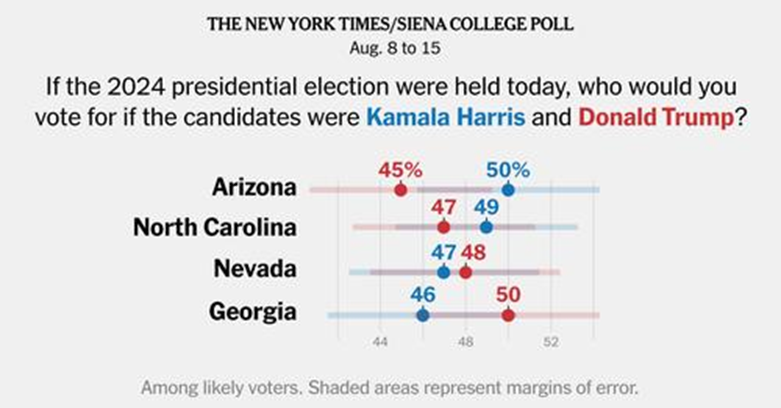
in general. Yesterday's story is an example. Yes, we can conclude that Harris is leading in Arizona, because her margin (barely) exceeds the margin of error (see the
figure below). But contrary to The Times, we cannot conclude with 95% confidence that either Harris or
Trump is leading in North Carolina, Nevada, or Georgia. Those survey margins
are within the margins of error, which are shown in the graph in the article.
By the usual definitions in political polling, those races are dead heats.
Remarks later in the story indicate what The Times
is really up to: "As the Harris and Trump
campaigns rush to define each other in the remade race, voters see a choice
between strength and compassion. Voters were about equally likely to see each
candidate as qualified and change-makers, but significantly more voters viewed
Mr. Trump as a strong leader....When voters were asked who 'cares about people
like me,' Ms. Harris had a slight edge over Mr. Trump: 52 percent compared to
48 percent."
The Times
seems to think that it can report results from a sample as if they held for the
population, as long as it labels results that hold with 95% confidence as
"significant." (The poll margin for the question about strong leaders
was 8%, much larger than the margin of error.) The Old Grey Lady is playing word
games. Most readers are not statisticians. When The Times says Harris has
"a slight edge," they think that The Times is talking about
the population, that is, the world outside of the sample. They view the word "significantly" as redundant.
So The
Times has it both ways. It tricks readers into believing that it is
breaking news by declaring a winner. And, if challenged, it can always point out that, after all, it
did refer to significance, sort of.
A
simple example will show why this is a cardinal sin. Suppose that the president
of General Motors misstated stock earnings for years. The Securities and Exchange
Commission would investigate and probably force the president to resign. He
might even face charges of fraud. Shouldn't we hold the nation's leading newspapers to standards at least as high? In a close race like this, newspaper reports of the polls affect donors. The money is sloshing towards Harris because of her perceived momentum. How real is that perception?
Another common dodge of newspapers: Well, do we really need 95% confidence that Candidate X is winning? Surely 90% is good enough. In that case, the margin of error is smaller, and the poll margin may now exceed it. We can then conclude that X is winning.
It is true that 95% is an arbitrary standard. But it is also a universal one, especially in political polling. To apply 95% in some cases and (quietly) 90% to others, which The Post is fond of doing, amounts to moving the goalposts at halftime for some games but not for others. It makes it hard to compare poll results. Is Harris ahead in certain polls because she is winning the race, or because those polls adjusted the margin of error until she was "winning"?
The Times and The Post say their polling staffs have graduate training in statistics. I do not see how a well-trained statistician can unknowingly make errors this basic. I will leave it at that.
Noncardinal sins....
There's more, much more. The Times
writes: "The polls show some risk for Ms. Harris as she rallies Democrats
to her cause, including that more registered voters view her as too liberal (43
percent) than those who say Mr. Trump is too conservative (33 percent)."
It is not clear why The Times says this shows "some risk" for
Harris. Perhaps it means that voters are significantly more likely to view
Harris as liberal than to view Trump as conservative. If that's what it means,
it should provide evidence. The margin of error applies here, too. But even if it is true that voters are more likely
to judge Harris as liberal than to judge Trump as conservative, why would this
be a risk for Harris?
The Times
continues, "For now, [Harris] is edging ahead of [Trump] among critical
independent voters." Evidence?
The Times
also writes, "Mr. Trump and Ms. Harris are tied at 48 percent across an
average of the four Sun Belt states in surveys conducted Aug. 8 to 15. That
marks a significant improvement for Democrats compared with May, when Mr. Trump
led Mr. Biden 50 percent to 41 percent across Arizona, Georgia, and Nevada in
the previous set of Times/Siena Sun Belt polls, which did not include
North Carolina."
The Times is comparing apples to oranges. One
sample includes North Carolina, the other doesn't. And it is not clear why it
bothers to make this top-level comparison. The polls differ from state to state,
and The Times has specific information about each. Why not stick to
reporting the results for each state poll rather than aggregate them into an
inferior measure?
If The Times simply must have a nation-level conclusion, it
can view each state poll as an observation in a sample of all state polls and
compute the probability that Harris is leading nationwide, given the sample of
state polls. Do the same for May.
Finally, a puzzle. In Arizona, The Times/Siena poll reports Harris
ahead in the sample by 5% among likely voters and 4% among registered voters.
But the poll by the Competitiveness Coalition/Public Opinion Strategies about
two weeks earlier reported Trump ahead by 5% among likely voters. And The
Hill/Emerson College poll about three weeks before The Times/Siena poll
reported Trump ahead among registered voters by 5%. Were these differences due
to Harris's momentum? Or were they due to differences in how the polls were
conducted?
Source: The New York Times
The key question: Are The Washington Post and The
New York Times statistically significant?
Anyway, these conundrums pertain to Central Asia because the political polling in the region, or at least the reporting of it, is anything but perfect. The margin of error is correspondingly higher. In short, politics pervade political statistics. --Leon Taylor, Seymour,
Indiana, tayloralmaty@gmail.com
Notes
For helpful comments, I thank but do not implicate Annabel
Benson, Richard Green, and Mark Kennet. Parts of this post draw upon my earlier
articles on my Facebook page.
References
Dan Balz, Scott Clement, and Emily Guskin. Kamala
Harris holds slight national lead over Donald Trump, Post-ABC-Ipsos poll finds
- The Washington Post August 18, 2024.
Shane Goldmacher and Ruth Igielnik. Kamala
Harris Puts Four Sun Belt States Back in Play, Times/Siena Polls Find - The New
York Times (nytimes.com) August 17,
2024.
Lisa Lerer and Ruth Igielnik. Harris
Leads Trump in Three Key States, Times/Siena Polls Find - The New York Times
(nytimes.com) August 10, 2024.